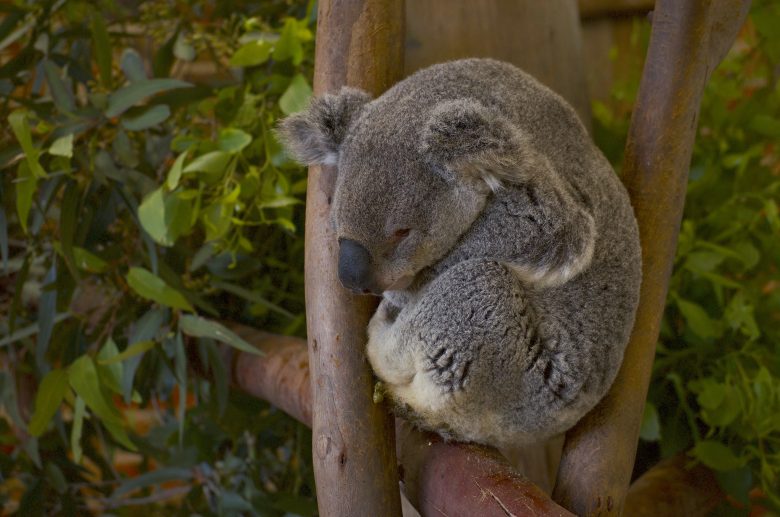
Koala, this iconic sweat Australian animal is a marsupial mammal native to Australia. The status of the small bear that charms my species with its fluffy ears and baby face, has been set as “vulnerable” due to its constant decrease of population. Having been recently in Australia and even if as a foreign tourists you have to go through a thorough inspection to be prevented from interfering with nature’s home, I noticed that Australians confess of not being skilled to preserve the land “given” to them. Besides, they already have in their hands the fate of the extinct Tazmanian dog. The path of he Aboriginal tribe through their history can be discussed in another post…
Among the main reasons widely known for the extinction of the koalas are stress and chlamydia. Chlamydia is a sexually-transmitted disease that causes blindness, pneumonia, and urinary and reproductive tract infections and death in Koalas. Their stress is mainly caused by human-induced threats like habitat loss, derived through deforestation, vehicle strikes, climate change etc… As Australia goes through a deforestation crisis, its deforestation rates being ranked in the highest 5 of the world.
So while the koalas are eliminated in a constant pace, I have been informed that scientific research is going on universities and specific measurements are taken by the government.
I have stumbled across one theory that koalas are a species that would adapt to an urban planning that includes them. Koalas would be located and hosted in the green areas of urban areas. These green areas seem to be taking the role of natural forest in the wild.
However, this seems to neglect the fact that these green urban areas are man made and therefore made to serve humans and their recreation as cities is expected to grow according to their population. Such an action implies a high density population of koalas in a limited territory leading long term to a mass starvation and widespread forest death while the wandering nature of koalas is set aside. Koalas are responsible for adapting to co-exist with human populations. Their survival depends on their ability to do so.
Furthermore, even if acknowledged as a vulnerable species in Australia (among other 790 spieces) the Australian laws do not seem to have they protective impact they should. The EPBC Act referral guidelines of the Australian government is aimed at people or companies wanting to develop land in known koala habitats in which any action which could have a significant impact on protected matters, including habitat destruction through land clearing, must be referred to the federal government for assessment. In order to proceed then they must have a permit and a koala management plan. These plans focus on locating koalas, ensuring that the trees koalas are sitting in at harvest are not felled, and on post-harvest surveys to find any injured koalas.
The Department strongly encourages proponents to engage qualified specialists to carry out surveys prior to making an assessment of their action or submitting a referral, to provide adequate information on the habitat attributes. Strongly encourages…The burden of proof thus reside with the proponent of a project to study thoroughly the project impact.
These constantly changing laws leave however room for interpretation in the limits set on companies. The criteria for “significant impact”, the term that underpins the entire referral process, and the absence of a clear definition of what an “important population” of koalas is makes the legal basis of any action very flexible. Laws use relative, broad and vague terms shaping a Koala Habitat Assessment Tool scoring system that decides if the action will affect the native animals life. This score relies on self-assessment of the effects on koalas by the proponents themselves. The proponents of the projects, due to the fuzzy words used, do have thus a legal basis to proceed undisturbed. In contrast to the koalas.

Assumptions about where koalas live can massively underestimate the impact of new infrastructure, the size of the habitat actually affected and where the koalas go after the plantation has been cut down, and what effects their movement has on the landscape and the surrounding native vegetation. In this way, surveys can miss or underestimate koala habitat while attempting to measure development impact. In addition, assessments of many small separate land developments does not give the real impact of the overall big unit development.
As a result, land clearances are often not referred to the federal government and are neither assessed nor approved.
The analysis showed that several million hectares of threatened species habitat has been cleared or destroyed since the legislation was enacted. Facts show that most of it it was not referred to the federal government and so was neither assessed nor approved. Even when companies or people did refer proposed actions, almost all were allowed to proceed (sometimes with conditions). The high approval rates may be derived, in part, from inconsistent application of the “significance” test under the federal laws. Because after all, people are allowed to be SELF-ASSESSING their activities and concluding they will NOT have a significant impact. A main detail and hint in the whole process is that deforestation takes place by companies for building development, commercial development, mining, transportation development.
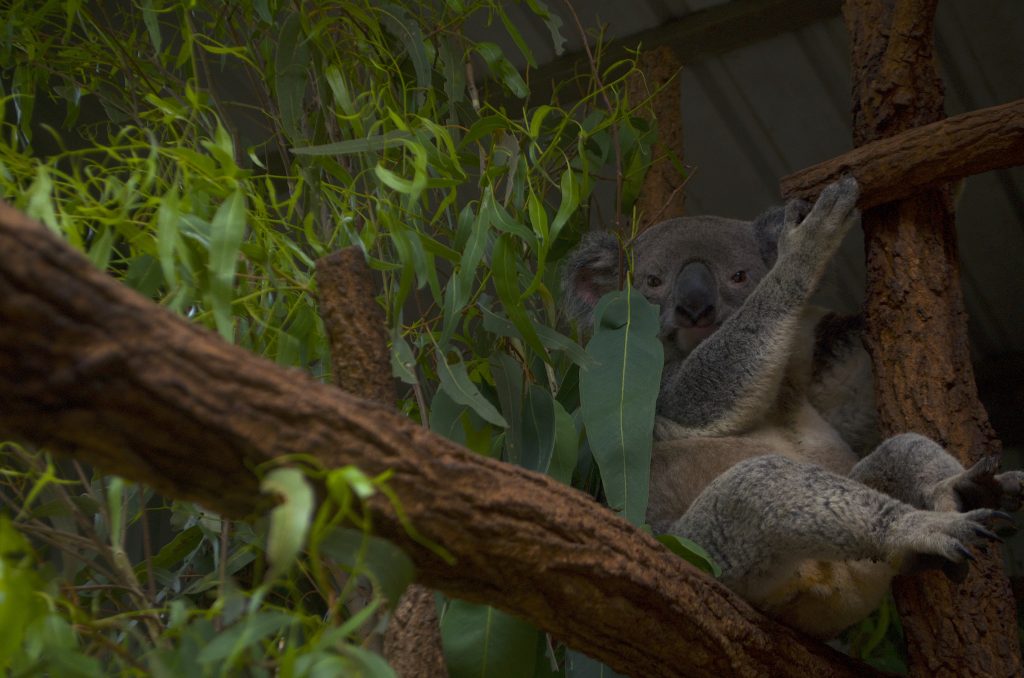
Somebody, let’s say myself, is thus left to wonder that if they are really researching the matter aiming its solution and the saving of the koalas then why does the most obvious solution not crosses the minds of the most clever minds occupying the universities. The learned connotation of a stress caused by the habitat loss would be to preserve the habitat. Full protection of the forests and the balancing of the ecosystem, implying immediate stop of deforestation.
Nevertheless, we occupy ourselves with theories forgetting the real matter. The real, or at least the one claimed, purpose. Papers are consequently published, presented with high importance in conferences, universities are praised raising their prestige rankings.
Companies are funding and the problem remains unsolved in practice.
This exctincting animal is often regarded as a nonchalant animal, because they sleep most (quantitatively speaking, the number used is 99%) of their time and seek for food and mating partners during their left time. However, koalas do experience stress. And for that is the human factor responsible. Climate change affecting the temperature and the only food of the diet of the koalas, as they are completely reliable solely on the eucalyptus tree, make it extremely susceptible to any changes. Bushfires occurring during heat waves, draughts, land clearances are hindering its feeding and water needs.
City farms may host a couple of somehow injured or endangered koalas for a short period until their rehabilitation, however this cases cannot save the species.

To conclude, it appears that we accept the human factors as they are and taking them as an unchanging basis to proceed for a solution. This will always derive to a solution only suiting “us”. Nature then, will always owe to fit with us.
Treating nature as an extracting reserve, as our own private commodity and thus diplomatically keep harming it by requesting to it to adapt to us, we disregard the danger of harming us. When universities, governments and companies walk hand in hand a path with this underlining mentality, just now covered with diplomacy, we cannot expect to adequately avoid, mitigate or compensate the damage.
Only if ecosystems are a common resource owned by none of us, it is us who should adapt our actions to the koalas and swallow the news.
A koala then is simply a free animal in its yard.