When the lockdown in the middle of March struck the globe, a new measure in the country I reside was, among others, the restricted amount of guests. Thus, if I prioritised this new law over my beloved ones, I had to pick out people and leave others out from my gatherings. It was without saying that meeting new people and socialising was not even a possibility. However, in these times in which the sun shines with a schedule and you would have to have a ticket to sunbath, I made a new friend. Unexpectedly. And illegally I guess. You can still find him roaming in the house up until today, I dare to stay…
It was a day that the view of my window was filling the moment while I was enjoying the only good part of the lockdown: my much more free time. We people strive to ensure more time in this life and if we do so, we face anxieties on how to fill this time we have. But that is another story. Enjoying so my free time, I went through my library when a book, that I had been planning for a lot of time to open, fell in my hands.
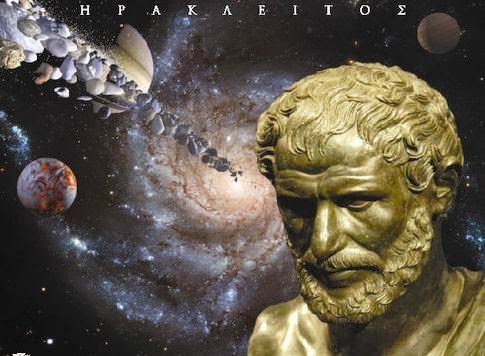
It was the legacy of Heraclitus.
As one of my other favourite ancient friends, he was not really popular in his times. Quite the opposite as he found no value towards the masses whom he held a strong aversion to as he considered most men useless and ignorant conformists. One of his nicknames was therefore “The Dark”. Another one was “The Riddler/The Obscure” as the only book we have in our hands today is comprised only by quotations which are difficult to decipher and leave room for interpretation. His style of paradoxical aphorisms was intended as he himself seems to have been a fan of those.
“The lord whose is the oracle at Delphi neither utters nor hides his meaning, but shows it by a sign.”
Now, what is it exactly that created the bond between me and my quarantine friend?
- LOGOS as the only objective truth
According to Heraclitus LOGOS is that which always exists, contains the eternal order of things, the eternal truth. It is the logical true word which is common for all and has not been made by a human or a god and it will alway be. It unveils the truth regarding the nature of all things and exists everywhere ordering and structuring reality. It does sound a bit like it is the universe itself, doesn’t it? Beyond it, before it and always.
Part of Heraclitus disdain towards the masses was due to their blindness towards this truth. He felt that the masses cannot foresee this truth and not even understand it after it has been explained. They find foreign all they encounter and are constantly in contrast with the Logos although they come everyday in touch with it. I guess it was already starting back then, as he claimed that the individuals tend to live as if they have private thought, and “at present they are absent”.
Hmmm, isn’t it for that “we think, that we therefore are”? Don’t we see now more than ever that our own opinions are represented as global truths? Don’t we dive into endless exchange of monologues in which our own private understandings are considered as the truth as such? And the more power, the more true.
It is very interesting to see that according to Heraclitus the wise is not the one who has collected and memorised all the information, as this erudition itself does not teach the deeper understanding of things. Wise is the one who investigates, who knows how to collect better the nature of relations that establish themselves between things.
- HARMONY as the PRODUCT OF OPPOSITES
For Heraclitus in Logos is also found that all is one, that the many are coming together in a single unity and the mystery of the one is in many. (I mean, how couldn’t I recognise The Ocean Feel in there?) Heraclitus beautifully portrayed that in the example of the lyre, in which “a stable harmonious sound emerges from the tension of the opposing forces that arise from the bow bound together by the string.” “This internal opposition of the bow and the string brings concord and out of the discord comes the fairest harmony.” An apparent harmony of the one conceals an underlining strife of opposing forces.
When all things come into being by conflict of opposites doesn’t this feel very relieving? When in our society only one side is allowed to exist and its opposite is to be exterminated, such a new (rather ancient) approach is revealing. Here, the great individual is actually the one who harbours a strong internal division, where evil and good passions are engaged in a battle with each other. It is through this battle that one develops strength insight and wisdom. Through the presence of opposites the great man, the bow with the great tension, as a whole develops. Doesn’t this give another dimension to the being itself?? An overwhelming one. Internal peace achieved through eternal war, since war is the universal, creative and decisive force of all.
Heraclitus added that in the sphere of opposites, they can only be assessed in relation to their opposites and that there is mutual succession and changing of things that are located at opposite ends of the same continuous (day/night, hunger/satiation, etc).
- CHANGE as the only stable
Taking these world of the unity of opposites, until then the opposed with the problem of what remains stable and same underneath changes was answered by specific suggestions of things. Heraclitus answered this questions by specifically defining that when everything is in flux, CHANGE as such, is the most stable among all. “Nothing endures but change”. Change is in our everyday life usually something very scary. Do we see that we people actually lead our lives so to control it as much as possible and keeping at bay any unexpected change? However, facing reality in a way in that “It is in changing that we find purpose” will allow a greater adaptability with maybe less fear, anger and sadness in our lives? Easier said than done of course, however is seems that another realm of freedom and revelation awaits us like this when realising that everything that comes to existence does so only through the destruction of something else.
So my illegal friend Heraclitus, keeps reminding me fundamental natural things I tend to forget in my routine existence. It seems to be his focus on not measuring what is continually changing within our minds, thoughts, consciousness and imagination that made him also friend (legal I think by that time) of Hegel, Nietzsche and Heidegger. Well, all good. My pleasure to share.
Thus, when everything is changing is even knowledge like this possible? Perceiving their world through our own illusory private beliefs, desires, insecurities and opinions doesn’t this leaves us blind to the magnificent and divine truth which nourishes and orders all things, pervades all things? And mainly I ask myself how possible are fruitful investigations in a simple exchange of interpretations? How dangerous even, when power is included?
If not reminding ourselves and finding the truth on one’s own, neither by academic study nor by listening to teachings, I am sure Heraclitus would see us still as masses spending our days sleepwalking.
“If you do not expect the unexpected, you will not find it; for it is hard to be sought out and difficult.”
Reading Heraclitus sounds like freeing oneself from fears, accepting what is, cancelling noise and living beyond. Uh la la, illegal. Definitely. Dangerously illegal.